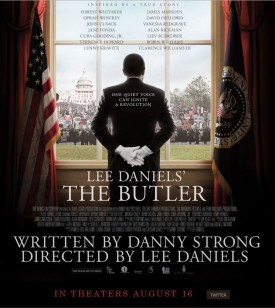
Title: Lee Daniels’ The Butler
Rating: PG-13
Cast: Forest Whitaker (Cecil Gaines), Oprah Winfrey (Gloria Gaines), David Oyelowo (Louis Gaines), Elijah Kelley (Charlie Gaines), Cuba Gooding Jr. (Carter Wilson), Lenny Kravitz (James Holloway), Robin Williams (Dwight D. Eisenhower), John Cusack (Richard Nixon), James Marsden (John F. Kennedy), Liev Schreiber (Lyndon B. Johnson), Alan Rickman (Ronald Reagan), Jane Fonda (Nancy Reagan)
Director: Lee Daniels
The Basics: The Butler is a sweeping portrait of the civil rights movement in America, told through the eyes of Cecil Gaines, who served as a butler in the White House from Eisenhower to Reagan. While the film highlights important moments in American history from inside the White House, the true heart of this film lies in Cecil’s house, where he struggles with an alcoholic but loving wife, a son in Vietnam, and another son making his voice heard as a Freedom Rider and later as a member of the Black Panther Party. This film takes the fight for equal rights—from a sharecropping field in the 1920s to the election of President Obama—and makes it intensely personal. This is a story that needs to be told, and its told through some truly fantastic performances. Yes, some of the presidential stunt casting was unbelievable to the point of taking away from the film, but, ultimately, what really mattered where the performances given by Whitaker, Winfrey, and Oyelowo. This trio of actors anchored the film with performances that were nuanced, powerful, and completely compelling.
M.V.P. (Most Valuable Performer): Without a strong actor taking on the role of Cecil, this film could have felt like a dry history lesson, jumping from one milestone to the next without any real emotional connection. Thankfully, Forest Whitaker gives his performance the quiet strength that we’ve come to expect from such a brilliant actor. Cecil never feels like a caricature or anything less than a real, three-dimensional person. We can feel the toll that years of hard work and suffering have taken on this man, but we can also feel the pride he takes in his job and the life he was able to build for his family. There is a quiet dignity to Whitaker’s performance that could get lost among the more flashy performances to come as “Oscar season” approaches. But his work should not be forgotten or lost in the shuffle because he is able to make you believe in this man and in the values by which he lives his life. It’s a testament to Whitaker’s performance that I found myself crying by the end of the film because I felt like I could understand what the election of President Obama would mean to Cecil Gaines. That ability to make the audience connect so strongly with a character in just a couple of hours is something only the best actors possess.
Scene Stealer: David Oyelowo might be a relative unknown (to me at least), but I walked away from this film incredibly impressed with him. There was such passion in his performance, and that uncontrolled fire of purpose worked so well opposite Whitaker’s more quietly powerful Cecil. The generation gap between Louis and Cecil is a driving force in this film, and it works because you are able to understand both sides of that gap. Whitaker makes you believe in Cecil’s reasons for acting the way he does (the murder of his father being the horrible foundation for his views on acting out too strongly), but Oyelowo also makes you understand Louis’s need to take action and to fight. He’s not just some rebellious kid; he’s someone who wants a better life for his future family the same way Cecil did. He doesn’t hate his father; he just doesn’t understand him. And that kind of universal struggle between generations takes on such a unique life in this film, a life that rings with authenticity because of the honesty Oyelowo gives to Louis’s journey.
Bring the Tissues? If you remain unmoved while watching Cecil react to the 2008 Election Night results, then I’m not sure you were really watching the movie. I was on the verge of tears a few times throughout the film, but that moment is what made me actually start crying because I could feel how much it meant to these characters, especially Cecil.
Most Memorable Scene: The generation gap that fuels the tension throughout the film comes to a powerful head in a dinner table confrontation between Cecil, Louis, Gloria, and Louis’s girlfriend. With Louis in his Black Panther clothing and his girlfriend sporting a huge afro while sitting with the modestly dressed Cecil and Gloria, the contrast is evident before any of the characters even begin speaking. And when they do begin speaking, it erupts into the best scene in the film. A discussion about Sidney Poitier turns from small-talk to fighting words when Louis scoffs at men like him and, by extension, his father. Louis’s inability to understand the pride his father takes in his job finally proves too much for the usually stoic Cecil, who explodes with a force we only see once in the film—but it’s enough.
But the true “scene stealing” moment belongs to Oprah. I know it’s been shown in every commercial and trailer for the film, but the moment when she slaps her son and tells him that everything he is and has is because of “that butler,” I still got chills like I was hearing it for the first time. And I wanted to cheer when she kicked his horrible girlfriend out of her house. I was worried going into the film that Oprah wouldn’t be able to disappear into this role as much as she would need to, but this scene was the moment when I knew my concerns were unfounded.





 Nerdy Girl Notes