TV Time: Once Upon a Time 5.19

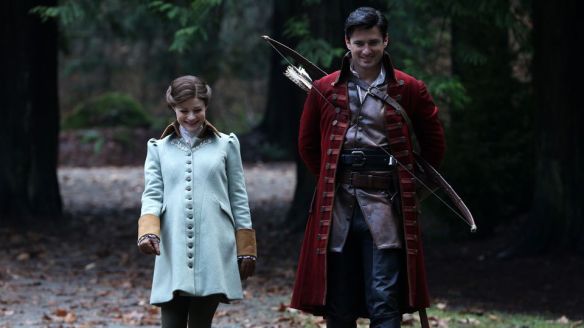
OUAT sisters

Source: abc.com

Title Sisters

Two-Sentence Summary When Regina enlists Cora to help stop Zelena and Hades’ blossoming romance, a major secret is revealed about a lost moment in the sisters’ shared past. Meanwhile, Charming finally comes face-to-face with James, and Rumplestiltskin reunites with a member of his family as he attempts to protect his child.

Favorite Line “You’re stronger than I ever was, and that’s a strength you got from the people you love—not from me.” (Cora, to Regina)

My Thoughts “Sisters” was a very focused hour of Once Upon a Time. It only had an A-story and a B-story, and both of them dealt with the same theme: the relationship between siblings. This was an episode that knew what it wanted to do (add important depth to the relationships between all three Mills women) and what it wanted to say (Love is strength, and only in accepting that can a person truly grow.), and that storytelling confidence from writers David H. Goodman and Brigitte Hales came through in every scene.

This episode’s main storyline (featuring Regina, Zelena, and Cora) was so strong that it could have stood on its own, and the depth and care it was given made the James/Charming showdown feel a little rushed in comparison. However, what that storyline lacked in depth, it made up for in intensity, and that’s all because of Josh Dallas’s performance. What could have been a silly gimmick actually felt tense. When Charming and James faced off, it felt like I was watching two distinct people who just happened to look alike, and that made the stakes feel higher than they would have felt in the hands of a lesser actor.

Dallas always seems to have fun playing James, but what struck me about his performance this time was how genuinely threatening James felt. When he pointed the gun at Robin, I was actually scared. James suddenly became a character to take very seriously rather than just a character playing out what could have been a stereotypical soap opera plot. So when his fight with his brother ended with him in the River of Lost Souls, it actually felt like it mattered because of the threat he posed. Emma was right—some people just can’t move on, and James was one of them. He was so consumed with jealousy that he never stopped to think about the fact that both he and Charming were hurt by what happened to them as babies. Instead of being able to move toward a place of understanding like Regina and Zelena are reaching, he sank deeper into his own darkness, stuck in his ways. So he now remains eternally stuck in that river, and Charming is left trying to process what he had to do.

However, unlike Belle and Rumplestiltskin (who also sent people into that river), Charming has a group of people who can help him as he deals with the repercussions of that fight. I loved seeing Emma lean on her father’s shoulder at the end, offering him comfort with that small gesture of support. And it seemed fitting that the person Charming ran into battle with was Killian, the man who’s become more like family to him than his own brother. This episode reminded us that families can help each other when no one else can, and Charming has a strong support system in his family, which surely factored into the monumental difference between him and his brother.

While the sibling rivalry between Charming and James played a part in this episode, it was a small part compared to the episode’s main event, which was a tale of two other siblings who were separated for most of their lives: Regina and Zelena. Once Upon a Time is at its strongest when it focuses on the complex female characters who have driven the story since the pilot, and “Sisters” was another amazing showcase for the variety of women and relationships between women that populate this world.
Continue reading

Scandal 5.18: “Till Death Do Us Part”

It’s time to welcome back Laura, who’s returned with her thoughts on the latest episode of Scandal!

I think that was one of the most painful episodes of Scandal that has ever aired, and there have definitely been some tragic storylines before. As a member of Team Jake, though, that episode truly broke my heart.

Here’s my main question: Jake knows Rowan, and he knows Rowan would do absolutely anything to see his plan succeed. Yet the things Olivia said to him at the church were so brutal, and they played on his every fear about the two of them together and all his insecurities that she could never truly love him and choose him. So would he be able to see past her act and figure out that Rowan was behind this? I wish he would, but I don’t know if any of us could see clearly after an assault like that. Still, I found myself hoping, even though he said “I do” to Vanessa, that deep down a part of him knew Olivia would never treat him like that. I desperately hope he knows she does love him and that she only said what she did to save his life. He has to know Rowan got to her somehow, right? What do you think? Is he too blinded by his broken heart to realize the truth?

Continue reading

TV Time: The Americans 4.06

the americans 406

Source: vox.com

Title: The Rat

Episode M.V.P.: Alison Wright
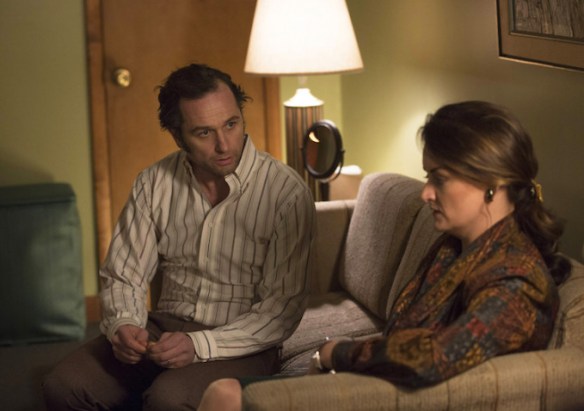
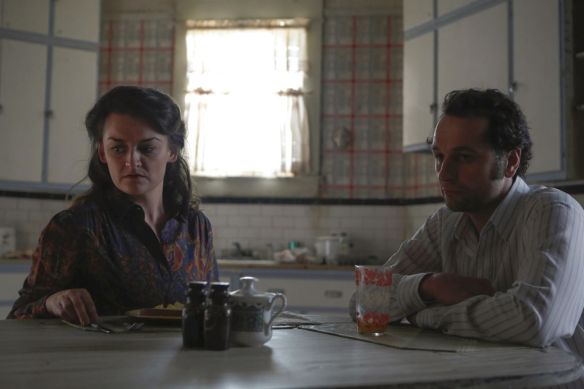
This is the second week in a row that Alison Wright shone the brightest among the many acting superstars in this talented cast. And what I loved most about her performance in “The Rat” was the way it grew naturally and realistically out of her performance in last week’s “Clark’s Place.” That episode showed Martha’s spirit beginning to die and resignation beginning to set in, and this episode showed that downward spiral continuing. Some of the most heartbreaking and chilling moments in “The Rat” were moments where the camera focused on Wright’s face when she was alone in a room and we were able to see the emptiness in her eyes. Martha may not be dead yet, but Wright’s performance continues to show us that she is a dead woman walking in more ways than one. It’s not easy to convey the death of someone’s entire reality without making it melodramatic, but Wright has made every step on this sad journey—including those horribly tense steps away from Gabriel and toward her own doom—feel grounded in a brutal kind of reality. Martha isn’t just a character we pity; she’s a character we empathize with, and that’s an important difference. Because most of us have—at some point—opened our hearts to someone and trusted them, only to find out they’re not exactly as advertised. It just so happens that Martha’s version of this story is a lot worse than most of ours.

Wright—like most of her fellow actors on this show—has a true talent for reacting. One of the most painful single shots of this episode was her reaction to Philip’s admission that he works for the KGB. Without any words, Wright made me feel sick to my stomach for her character. Through the slight sinking of her posture, Wright showed the brutal force of Philip’s confession while still leaving enough ambiguity in her performance to hint that Martha probably knew in her gut that this was a possibility. But Philip confirming it destroyed any last ability she had left to remain in denial about who she’d been helping, and the weight of that makes her physically shrink, as if she’d lost another part of herself.

Following that stunning moment, Wright showed Martha’s desperation to remain in denial about one final thing: her husband’s love for her. I don’t think I’ve ever seen a sadder sex scene on television. It was hard to watch, and the reason I felt so uncomfortable during it was because of how completely broken Martha was and how vulnerable Wright’s performance was in showing Martha’s desperate desire to cling to this final lie. And once that final lie seemed to be over—once Martha woke up and Philip was gone—it was easy to believe this woman would snap. The way Wright’s performance over episodes and whole seasons  built to that confrontation with Gabriel was nothing short of brilliant. For the first time, Martha chose herself, but in choosing to walk away, she most likely signed her own death certificate. It feels now like we’re living on borrowed time when it comes to appreciating Wright’s talent, and I plan to use all the time we have left to scream from the rooftops (or at least whisper-shout in the middle of the street) about how good she is.

Continue reading

TV Time: Once Upon a Time 5.18

Title Ruby Slippers

Two-Sentence Summary After Ruby lands in the Underworld, she begins searching for a way to return to Oz and wake Dorothy from a sleeping curse, which ultimately leads Snow and Charming to discover a way for one of them to return to Storybrooke to be with their son. As Ruby worries about who will give Dorothy True Love’s Kiss, Snow helps her see that the answer is clear: It’s Ruby herself, who we see fall in love with Dorothy during flashbacks to her time in Oz with Mulan.

Favorite Line “What you get back when you love someone far outweighs the risk.” (Snow)

My Thoughts Love, hope, and courage are deeply connected on Once Upon a Time. It takes courage to open your heart to the hope that someone could see all of you and still choose to love you. And it takes courage to allow yourself to hope that your love for someone—and theirs for you—is strong enough to create magic.

In the words of Snow White, “Love is freaking scary.” (How perfect was Ginnifer Goodwin’s delivery of that line, by the way?) But as Snow also said last week, “Love is worth it.” Love of all kinds is worth fighting for. Love may be scary, but love also makes us brave.

Continue reading

The Best Thing I Saw on TV This Week (4/10 – 4/17)

This week in television started off with a closer look at Belle’s character on Sunday’s episode of Once Upon a Time. Monday gave us Disney night on Dancing with the Stars, Jane’s bachelorette party on Jane the Virgin, and one of the most uplifting Castle moments of this season when Ryan and Jenny’s new baby boy was born (and given the perfect middle name of Esposito). On Tuesday, Brooklyn Nine-Nine‘s penultimate episode made me laugh harder than any episode of television so far this season, while The Mindy Project‘s big return made me cry (while also making me feel so proud of Mindy). Wednesday’s episode of Nashville took the drama—especially surrounding Maddie—up another notch, and on The Americans, certain characters found a way to release some of their own tension while others found their anxiety reaching a fever pitch with no release in sight. On Thursday, Orphan Black premiered with a look at Beth’s story, and on Friday, the impossibly charming Unbreakable Kimmy Schmidt returned to Netflix.

When many TV shows seem to be going to very dark places, it’s nice to take a moment to celebrate shows that still make us laugh. And Brooklyn Nine-Nine was at its comedic best on Tuesday night. “Bureau” had so many highlights that I can’t pick just one for the best moment on television this week. But I will single out Andre Braugher as the week’s best performer. Whether he was talking about his lint (which was oblong and blue, in case you were wondering) or describing the plot of Sex and the City, he proved once again why it’s a crime that he hasn’t won an Emmy for this role yet. I hope this is his submission episode for this season, because I can’t think of a better example of his talent.

What was the best thing you saw on TV this week? And would anyone else like to sign a petition for FOX to create a web series in which Captain Holt reviews TV shows?

TV Time: The Americans 4.05

Title: Clark’s Place

Episode M.V.P.: Alison Wright
A common refrain in Storytelling 101 is “Show, don’t tell.” But sometimes a moment of telling can be even more moving and engaging than a moment of showing. You just have to find the right storyteller. And The Americans has found that with Alison Wright. So many of Wright’s scenes—especially since about midway through last season—have involved Martha telling “Clark” about how she feels. But what’s important to remember is that these scenes exist because Martha often can’t show her husband how she feels, because he’s not there. So she has to make him—or at least try to make him—understand her anxiety, her loneliness, and her frustration in those moments when he’s gone in whatever way she can. And in making him understand, she makes us understand, too.

That’s the surprising beauty of Wright’s performance: She manages to show and tell at the same time. For example, in the first scene of “Clark’s Place,” she doesn’t just tell “Clark” (and the audience) about her panic attack, she brings it to life in a way that’s more gripping than a flashback to her having that panic attack in the last episode. Because not only do we feel her panic at the mere memory of thinking she was having a heart attack and was going to die alone, we feel the myriad of other emotions she feels in the present, too. We feel her shame at being prescribed Valium to deal with her anxiety. We feel her frustration with herself for letting her life get so out of control and with her husband for turning her life upside-down. And we feel her increasing sense of loss—the loss of the fantasy that was her marriage, the loss of any kind of a normal life, and the loss of her sense of self. Because when Wright delivers those lines about her dinner with Aderholt and the panic attack afterward, it’s not really about the lines she’s saying; it’s about the weight of the suffocating emotions she puts into every word.

The thing that impressed me the most about Wright in this episode was the way she’s changed Martha’s reactions over time. Yes, her tears while telling her husband about her panic attack broke my heart, but what really stood out to me was her growing understanding and heartbreaking acceptance of the fact that she might be married, but she’s really alone. She’s not desperate anymore; she’s resigned. Even when things started to fall apart last season, I felt as if she still believed she and “Clark” were a team. Now, however, it’s killing me to watch her sink deeper and deeper into a sense of resigned loneliness with no one to help pull her out of it.

Martha knows she’s trapped, and watching that sense of resignation make its way into Wright’s line readings (“Why would I expect to keep anything?”) made me want to cry. This episode was like watching a character’s spirit and soul die before they actually die, which might be even more tragic than watching Nina get shot in the back of the head last week. And so much of that pathos comes from Wright’s performance.

Continue reading

Fangirl Thursday: Look for the Hope

It’s been an emotionally draining, depressing, and frustrating few weeks in various fandoms. It seems TV show after TV show has been doubling down on the idea that shocking deaths make for good television, without thinking about what certain deaths might mean for large groups of their fans. And even if characters aren’t dying on your favorite show, chances are it’s still gone into darker territory this season. It seems almost every show I watch has dealt with heavier material this year. Even the usually light Brooklyn Nine-Nine ended with an atypical life-threatening cliffhanger this week. (Even though I think we’re all 99.9% sure Holt’s going to be fine.) And the offerings at movie theaters aren’t much better lately, with superheroes fighting each other all over the place.

In short, if you feel a little beaten down by the media you’re consuming lately, you’re not alone.

There’s a tendency to judge the quality of a piece of media by how serious it is. Most of the “prestige dramas” we hear so much about are incredibly heavy and often bleak. So people often stick with television shows that make them feel hopeless and upset more often than not because they think that’s what “good” television is supposed to do. They think that walking away from a TV show when it starts to feel oppressively negative says bad things about them as a viewer instead of bad things about the show that made them walk away. Because a good drama can never be “too dark,” right?

WRONG.

It’s not just okay to walk away from a TV show when it starts negatively affecting your emotions on a consistent basis; it’s smart. There’s nothing wrong with putting your mental and emotional health above a television show’s ratings or your reputation as a fangirl or fanboy. Even if you loved a show for years, if it’s making you feel miserable or triggering you in some way, you’re not less of a fan if you stop watching something that’s not good or healthy for you anymore.

This trend of prioritizing shock value above quality character development needs to stop. This is especially true when the shock value comes from killing or traumatizing characters simply to show that no character is safe and that the world they inhabit is awful. If a character dies, that death should mean something—and not just that anyone can die. And if a character is put through a traumatic situation, it should be treated with care not just in that moment, but in all the moments that follow it. Death, beatings, torture, and rape shouldn’t be added to stories only to get people talking or to show how horrible a person or a society is. They should resonate thematically; they should carry weight not just in one episode, but throughout the rest of the series. They should matter.

Continue reading

TV Time: Once Upon a Time 5.17

OUAT 517

Source: avclub.com

Title Her Handsome Hero

Two-Sentence Summary With Belle and Rumplestiltskin working together to try to save their unborn baby from Hades, the Lord of the Underworld enlists a familiar face from Belle’s past to throw a wrench into their plans: Gaston. Meanwhile, Emma’s nightmare of a beast attacking her mother forces her to confront her guilt about her family’s participation in her quest to save Killian.

Favorite Line “We knew it would be hard—these things always are—but some things are worth it. Love is worth it.” (Snow)

My Thoughts Hope is the strongest force of good there is on Once Upon a Time, and the opposite is also true: Hopelessness is the strongest agent of darkness. So much of this Underworld arc has focused on the way hope can take root in the darkest places, but that can only happen when hope is shared. When someone feels like they’re alone in hoping for the best, it’s easy for them to lose that hope when things get hard. And when that happens, it also becomes easy for them to open themselves up to darkness.

I really loved the visual symbolism in this episode of hope being a flower growing amid the decay of the Underworld. Like a flower, hope can’t grow in darkness, but light makes it grow strong. And Emma and her loved ones have brought light to the Underworld. These characters have a deep sense of hope, and they don’t just keep it to themselves. They’re heroes because they work to share that hope with others, and they’ve done that not just by giving hope to those who have since moved on, but also by continuing to give hope to each other when the darkness around them starts to feel overwhelming.

On the opposite end of the spectrum are Rumplestiltskin and Belle. Hope has never been something Rumplestiltskin has understood. He’s a coward, and fear and hopelessness are often deeply connected. But what made “Her Handsome Hero” so sad was the fact that Belle is also feeling hopeless now—not just concerning the fate of her child but concerning her entire belief system and her sense of self.

Continue reading

The Best Thing I Saw on TV This Week (4/3-4/10)

This was a great week for partnerships on television. Sunday’s episode of Once Upon a Time introduced a new potential pairing in the unexpected relationship between Zelena and Hades. On Monday, strong partnerships created some memorable routines to go along with memorable years on Dancing with the Stars. Tuesday’s episode of Brooklyn Nine-Nine featured a pleasantly surprising bit of honest and open conversation between Jake and Amy during an undercover operation, and American Crime Story: The People v. O.J. Simpson ended with plenty of emotion and another reminder that the show’s version of Marcia Clark and Chris Darden’s partnership helped make it must-see TV each week. On Wednesday, Juliette returned to Nashville, which ignited some hope in my “shipper” heart that she and Avery might be able to rekindle their partnership someday. Also on Wednesday, The Americans started by putting its central partners in quarantine and ended with a sad death in a lonely prison basement.  American Idol also ended this week, and I’d be lying if I said the reunion of Ryan Seacrest and Brian Dunkleman wasn’t one of my favorite things about that finale. Finally, Outlander returned on Saturday with a start I never saw coming but an ending that reminded me how much I love spending time swooning over Jamie and Claire.

Out of all the great moments between great partners this week, nothing topped the work done by two of the best scene partners on television right now: Keri Russell and Matthew Rhys on The Americans. In this week’s episode, the two shared a scene in a dimly lit bathroom that I have watched probably close to 10 times since it aired because it’s taken that many times to even come close to catching all the nuances in their performances. Watching Elizabeth have to work through the reality that she could die was painful enough, but nothing prepared me for watching Philip work through it. It was hard to see the normally stoic and strong Elizabeth look and sound so fragile and weak. (The statuesque Russell’s hunched posture in that scene conveyed so much.) But it just about destroyed me to watch Philip refuse to even consider a life without his wife and then almost fall apart when forced to consider it. In just a few short lines, Elizabeth showed how much her family has come to mean to her and how much their happiness now comes before them carrying on the mission. And in even fewer lines, Philip showed just how much Elizabeth means to him. Rhys and Russell have always made me believe the depth of feeling between their characters without ever making it feel forced, and that depth of feeling was like a warm light in that dim bathroom, adding another layer of honesty and emotion to TV’s best marriage.

Here’s a link to a GIF-set of this scene in case you want your heart to be broken by Matthew Rhys’s face. 

What was the best thing you saw on TV this week?

Scandal 5.17: “Thwack!”

It’s my pleasure to welcome Laura back for this week’s look at the world of Scandal!

Certain lines, once crossed, change everything. Olivia went to a place in this week’s episode that she can never come back from. For the first time, she has blood on her own hands—and face and clothes, for that matter. In this particular case, though, I found myself siding with Olivia. Her kidnapping ordeal knocked her white hat off. It’s hard to fathom the psychological repercussions of being abducted from your home, locked in a cell without knowing if you’ll live or die, and sold to the highest bidder. If someone did that to me, I’d probably want to bash his head in with a chair too, especially if he insulted me as horribly as Andrew insulted Olivia.

The things that struck me most in this episode, though, were the role Abby played and Olivia’s actions after she killed Andrew.

Continue reading