
Source: tv.com
I apologize for making like the Statue of Liberty and disappearing for a while, but between a wonderfully long Disney World vacation and the holiday weekend, I haven’t had much time to write! But before I get back to writing, I think we should all take a minute and share a collective happy sigh over the news that Keri Russell and Matthew Rhys welcomed their new baby into the world earlier this month. Congratulations to them!
Title: Dinner For Seven
Episode M.V.P.: Keri Russell
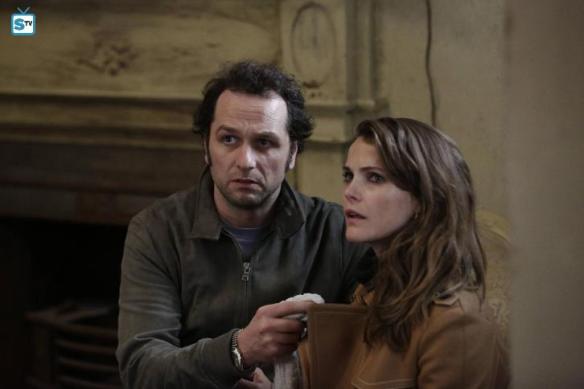
Consider this a cumulative M.V.P. award for Russell’s outstanding work in the last bunch of episodes. Her performance throughout this Don/Young Hee arc has been a thing of layered, complex beauty—some of her best work on this show to date. And her performance in this episode was no exception. Russell has taken Elizabeth to an intensely vulnerable place in these last few weeks, and she’s done so in a way that feels true to this character, who still believes she’s not supposed to have emotional reactions to her job. Elizabeth isn’t going to break down sobbing over losing someone she considered a friend, and she’s not going to have a heart-to-heart talk with anyone about what she had to do to a beautiful family. Instead, she’s going to show her guilt, grief, and emotional exhaustion in the tiniest but most heartbreaking ways: crying even after she leaves Don and doesn’t need to act heartbroken anymore, closing her eyes tighter when Philip holds her, and hanging up the phone with shaking hands when she hears Young Hee crying. This is what happens when Elizabeth’s carefully compartmentalized emotions start seeping out of their compartments, and it’s fascinating to watch her begin to struggle with the idea that the human cost of what she’s doing—including what she’s doing to herself—might be too much.
Russell was brilliant throughout this episode, but her masterfully subtle take on Elizabeth’s emotional awakening was best shown through her scenes with Pastor Tim. In their first interaction, Elizabeth was clearly still seeing him as an opposing force. Her posture, her tone of voice, and her choice of words were all careful and professional. In their first scene alone in the church, Elizabeth’s softness still felt like an act, and we could see she was still dealing with him as a potential threat. However, by her final scene with him, those lines between sincerity and artifice were blurred in the way only this show can blur them. The way she searched for words, the soft way she spoke, and the lost look in her eyes made me believe at least some part of her was really trying to get advice about finding clarity and comfort when things feel overwhelming. Of course, part of her was probably saying those things to keep him close and to manage him like any other asset. However, Russell played that moment with just enough vulnerability that I could feel the truth in what Elizabeth was saying about her mental and emotional state.
Elizabeth’s growing vulnerability and clear unease with what she’s been asked to do contrasted so well with the episode’s final scene, which reminded us that she’s still a trained killer who should be feared. The way her body snapped into action so instinctively was amazing, and I was captivated by the feral look in her eyes as she protected herself and her daughter and also by the businesslike way she dealt with the aftermath—with just a hint of concern in her eyes about what her child just witnessed. Elizabeth Jennings is one of the most fascinating female characters on television, and the woman who brings her to life each week deserves every bit of recognition imaginable for bringing such powerful complexity to this role.




 Nerdy Girl Notes