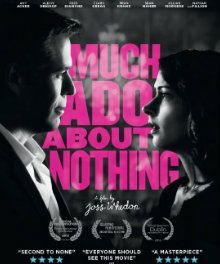
Title: Much Ado About Nothing
Rating: PG-13
Cast: Amy Acker (Beatrice), Alexis Denisof (Benedick), Clark Gregg (Leonato), Jillian Morgese (Hero), Fran Kranz (Claudio), Reed Diamond (Don Pedro), Sean Maher (Don John), Nathan Fillion (Dogberry)
Director: Joss Whedon
The Basics: This most recent cinematic version of Shakespeare’s classic comedy tells the story of two relationships: the love-at-first sight romance between Hero and Claudio and the bickering buildup of love and passion between Beatrice and Benedick. A game of matchmaking initially draws the latter couple closer together, but it’s only when Benedick sides with Beatrice after her cousin Hero is wrongly shamed by Claudio that the two fall in love in earnest. Set in modern times but told using all of Shakespeare’s dialogue (though it has been slightly condensed), Joss Whedon’s take on this story heightens all of its comedy as well as all of its tragic undertones. This film is already the stuff of legend for being shot in only 12 days in Whedon’s own home, and it deserves all the praise that can be sent its way. The cast is brilliant, the direction is smart, and the cinematography is gorgeous. In a movie season usually filled with explosions and animated characters, Much Ado About Nothing is a welcome bit of culture and substance—while still being a whole lot of fun.
M.V.P. (Most Valuable Performer): I didn’t know much about Amy Acker going into this movie: I knew her from her small roles on Alias and Once Upon a Time, and I knew she was a popular Whedonverse actress—but that was it. It took only a few minutes for me to be completely bowled over by her talents and her charm, and now I want to see everything she’s ever been in (and I want her to be the lead in many more films after this one). Acker was truly the perfect Beatrice. Shakespearean English doesn’t sound great coming out of everyone’s mouth, but each line of dialogue rolled off her tongue like she was born to play this role. She brought such a compelling mixture of poise and spunk to her performance, deftly balancing both the comedy of the part and its dramatic moments. Acker proved to be great at both physical comedy (falling down the stairs upon hearing of Benedick’s affection for her) and verbal sparring matches (with her well-matched partner, Alexis Denisof). However, I found her to be most compelling in Beatrice’s darker and quieter moments. Her delivery of Beatrice’s “Oh that I were a man!” monologue was incredibly powerful; I felt all of her pain, anger, and helplessness. And I bought every step along the way in her relationship with Benedick. Acker positively glowed in her softer moments with Denisof, creating a Beatrice who is a gorgeously multifaceted character in life and in love.
Scene Stealer: Much Ado About Nothing is first and foremost a comedy, and the funniest thing about thing about this film was Nathan Fillion’s performance as the pompous-yet-inept officer of the law, Dogberry. He played the part with a shocking amount of subtlety, considering how easy it could be to go overboard with this kind of role. And that decision made every moment he was on screen all the funnier. Fillion, like Acker, delivered each line like he came out of the womb reading Shakespeare, his smooth voice and great comedic timing working their magic to full effect. His gift for physical comedy was also on display, and those small moments—from trying to get on a suit jacket that’s far too small to locking himself out of his car at the end of the film—were just perfect. As a huge fan of Fillion’s work on Castle, it was fun to see the role reversal of him playing a cop, even if Dogberry might be the most ridiculous (and yet ultimately effective) cop in literary history.
Bring the Tissues: While there are some very powerful emotional moments, this is still a Shakespearean comedy, which means you can probably leave the tissues at home for this one.
Should I Stay or Should I Go? There’s nothing hidden after the credits for this film.
Most Memorable Scene: This film felt like a string of one memorable scene after another: the first party scene (which I found more fun and more entertaining than the first party in Baz Luhrmann’s The Great Gatsby), all of the matchmaking exploits (Denisof’s attemps to eavesdrop made me cry with laughter), Hero and Caludio’s dramatic wedding, every scene featuring Dogberry, the joyous party at the end…
But if I had to pick just one scene, I think my selection would be surprisingly dramatic for a Shakespearean comedy. The scene where Beatrice and Benedick confess their love after Hero’s wedding disaster was incredibly powerful. Acker and Denisof both brought such a sense of total commitment to that scene and to each other as scene partners—it was a beautiful thing to behold. Acker’s grief was painfully palpable; I believed every tear that ran down her face. And Denisof was equally convincing in his dedication to her and his desire to do whatever it takes to make her pain end. This scene jumps back and forth so sharply between tragedy and romance that it calls for two actors who are strong as individuals but even stronger together, and that’s exactly what Acker and Denisof were in this film. This scene was the best showcase for their chemistry. Yes, I loved their bantering scenes, but this scene—with its sweeping undercurrent of passion and devotion—made me truly believe the love between Beatrice and Benedick in a way I don’t normally believe most Shakespearean love stories.


 Nerdy Girl Notes